
· Maren Alcott
Silk or Satin Scarf for Heatless Curls: How to Tie It Over Your Rods
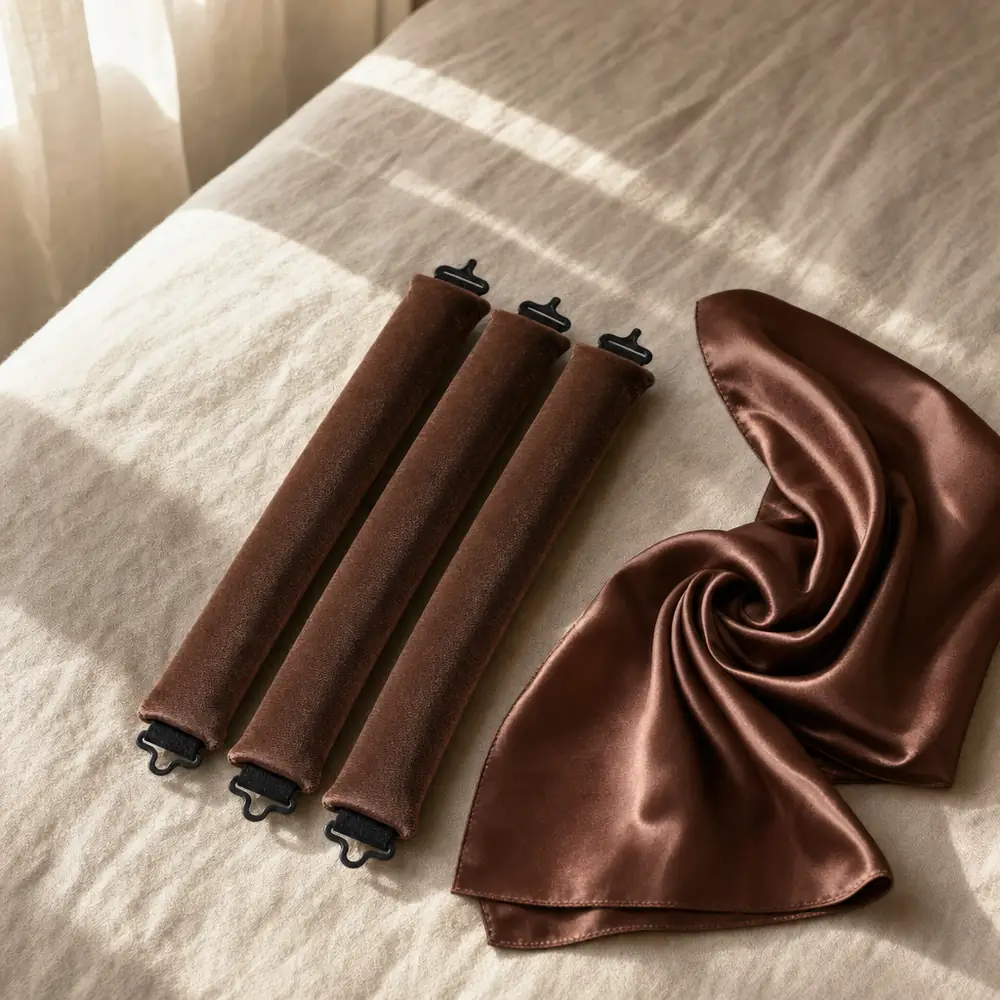
The scarf is the last step of an overnight set, and the one that keeps every other step in place. Tied well, it holds your three rolls snug against your head while you sleep and gives them a smooth cover to rest on, so you wake up to soft, voluminous waves instead of a roll that slipped loose in the night.
This guide is all about that final step with the Lunelock heatless curling rod set, whose satin scarf is a 27.5 × 27.5 in (70 × 70 cm) square in the same color as its three rods. You’ll find the tie step by step, two variations for the daytime and the morning after, the real difference between silk and satin, what the size of the square makes possible, and general care tips for polyester satin.
Why a satin scarf goes over heatless curls
A heatless set is hair drying into a shape. Each section has to stay wrapped around its rod until it is completely dry, and on an overnight set that happens while you sleep. The scarf does two jobs at once: it holds all three rolls against your head, and it covers them with one smooth layer, so nothing unwinds while you are asleep. How damp your hair should be at bedtime, and why, is covered in the guide to heatless curls overnight.
Sleep is also less still than it feels. In a study that tracked the nights of 664 working adults with body-worn sensors, people changed position again and again:
Position shifts per hour in bed, on average, among 664 working adults whose sleep positions were tracked with body-worn accelerometers.
Every turn presses a roll into the pillow and pulls at whatever covers it. A scarf tied snug keeps the rolls where you put them, and a smooth one lets your head turn on the pillowcase instead of dragging across it. That is the case for tying satin over the set rather than cotton.
Is silk or satin good for curly hair?
Yes, and for the same reason: both give curls and waves a smooth surface to rest on. Friction matters here: the more a surface drags on hair, the more force every movement puts on it. TRI Princeton, a not-for-profit institute that studies how hair and skin interact with materials, reports that its hair friction tests found a lower friction force between silk and hair than between cotton and hair. Satin is chosen for its surface too. A 1930 fabric-friction paper from the US National Bureau of Standards put it simply: “A smooth surface is more slippery than a napped surface.”
The hair side counts as well, since friction depends on both surfaces:
How much lower the initial friction of hair fibers was when they carried conditioner or natural sebum, compared with bare fibers, in work by Bowen and co-workers
— TRI Princeton, 2025
So detangle and condition as usual before you roll, and let the satin take care of the night. If you are weighing heatless styling against hot tools for the sake of your hair, read do heatless curls damage your hair.
How to wrap hair in a satin scarf for heatless curls
Tying a scarf over heatless curlers is the easiest part of the routine, and it always comes last. The rolls follow the photo guide in the box: one on top, above your forehead, and one on each side, each wrapped from the ends toward the roots. If you have not rolled yet, start with the heatless curling rod tutorial, then come back here for the scarf.
- Finish the three rolls. Check that each rod rests against your head, with no loose ends hanging below it.
- Fold the square. For full coverage, fold it corner to corner into a triangle. For a lighter tie that leaves more of the rolls in view, keep folding the triangle from its point toward the long edge until you have a band about the width of your palm.
- Center it at your nape. Lay the long edge of the triangle, or the middle of the band, against the back of your neck. With a triangle, the point faces up toward your crown.
- Bring the ends up over the side rolls. Draw both ends up along the sides of your head, so the fabric covers each side roll and holds it gently against your head.
- Meet behind the front roll. Bring the ends together on top of your head, just behind the front roll, so the front roll stays uncovered in front of the knot.
- Knot, then bow. Tie a first knot snug enough that the rolls stay put when you shake your head gently, then finish with a soft bow. With a triangle, tuck the point under the knot.
- Smooth the sides. Run your palms over each side, so there is no fold under the cheek you sleep on.
When the tie is right, you barely notice it, as one buyer put it:
“works, is comfy and stayed on all night”— Verified buyer
How tight should the scarf be?
Snug, not tight. The scarf should hold each roll against your head without pressing hard anywhere, and you should be able to slide a finger under it at your nape. If the rolls shift when you nod, retie the first knot a little firmer; if you feel pressure at your temples, loosen it.
Where should the knot sit?
On top of your head, just behind the front roll. The knot is the thickest point of the tie, and up there it stays off the pillow whether you sleep on your back or on your side. That matters, because the side is where most of the night is spent:
Share of their time in bed that 664 working adults spent lying on their side, in a study that tracked sleep positions with body-worn accelerometers.
Triangle or band?
Both tie the same way; they differ in how much they cover. Pick the fold that suits your hair and the moment.
| Tie | How to fold | What it covers | Best for |
|---|---|---|---|
| Triangle | Corner to corner, once | Back of the head and both side rolls | Overnight, long or thick hair |
| Band | Triangle folded to palm width | Both side rolls, front roll in view | Short hair, a lighter feel |
| Headwrap | Triangle, worn fuller | All but the front roll | Keeping the set in by day |
| Pineapple band | Band | The hairline only | The night after the set |
Long, thick hair makes fuller rolls, so the extra coverage of the triangle is welcome; the rolling side is covered in heatless curlers for long hair. On a short cut, the band keeps the tie light and the rolls in view; see heatless curls for short hair.
Headwrap and pineapple: two more ways to tie it
The headwrap: rolls in, out the door
The same tie reads as a vintage headwrap, so the set can look at home in daylight too. On a morning when your hair needs more time to dry, leave the rolls in, retie the triangle a little fuller so it covers the back of your head completely, and get on with your coffee and your makeup. Set the bow slightly off-center if you like the look. Because the scarf always matches the rods, the whole thing stays coordinated in any of the eight colors: Coffee, Black, Khaki, Pink, Wine, Navy, Beige and Sky Blue.
The pineapple: for the morning after
Once the rolls come out, the scarf keeps working. On the second night, gather your waves loosely at the very top of your head in a pineapple, held with a soft scrunchie of your own. Fold the scarf into a band, center it at your nape, bring the ends up around your hairline and tie the bow at the front, just ahead of the pineapple, so the lengths stay free on top instead of being crushed. In the morning, untie it, shake the waves out with your fingers and go. The full second-night routine is in how to make heatless curls last.
Silk or satin: a fiber versus a weave
The two words often travel together because satin can be woven from silk. What gives any satin its glide, though, is the structure. CottonWorks, the textile education site of Cotton Incorporated, explains that in a satin weave the interlacing points never touch one another, which leaves long floats of yarn on the surface of the fabric:
Crosswise yarns that each lengthwise yarn floats over in the 5-harness satin, the most common satin weave, before dipping under one; a plain weave goes over one, then under the next.
Those floats are what your hair touches: long, smooth stretches of yarn instead of a tight grid of crossings. The fiber changes other things. Silk is a natural protein fiber, polyester is synthetic, and the two call for different care. For a square tied over three rolls, the quality that matters most, a smooth face, comes from the weave.
| Silk | Satin | |
|---|---|---|
| What the word names | A fiber | A weave |
| What it is | The filament a silkworm spins | Yarns floated over several others |
| Made from | Silkworm cocoons | Silk or synthetic filaments |
| Surface | Depends on the weave | Glossy face, duller back |
| Everyday care | Follow its care label | Polyester: cold hand wash |
Is silk or velvet better for heatless curls?
They do different jobs, and the set gives you both surfaces. The plush side is what your hair wraps around: each rod is a foam core under a velvet-soft cover, 10.6 in long and 1.4 in thick (27 × 3.5 cm). The smooth side is the satin that goes on top. How silk, satin and velvet compare as roller covers is a question of its own, answered in satin vs velvet heatless curlers.
What a 27.5 in square lets you do
The scarf in the set is a 27.5 × 27.5 in (70 × 70 cm) square. A square is an adaptable shape for a scarf, because it folds three useful ways, and each fold changes the longest length you have to tie with.
| Fold | Longest length | What you get |
|---|---|---|
| Flat | 27.5 in (70 cm) a side | 756 sq in (4,900 cm²) of fabric |
| Edge to edge | 27.5 in (70 cm) | A 27.5 × 13.75 in (70 × 35 cm) double layer |
| Corner to corner | 38.9 in (99 cm) | A two-layer triangle, 19.4 in (49.5 cm) deep |
| Triangle into a band | Up to 38.9 in (99 cm) | A band as narrow as you want |
The diagonal is the number that matters. A square’s diagonal is its side multiplied by the square root of 2, about 1.41, so folding corner to corner turns a 27.5 in (70 cm) length into 38.9 in (99 cm): 11.4 in (29 cm) more than folding edge to edge. That extra length is what travels from your nape over both side rolls and still leaves two tails for the bow on top. It is also more than three and a half times the length of one rod, 10.6 in (27 cm).
Depth counts too. The triangle measures 19.4 in (49.5 cm) from its long edge to its point, a generous depth for the fuller headwrap. And every fold adds layers: the triangle is two layers thick everywhere, while the band stacks several, which gives the bow some body. Since the rods and the scarf share one color, whichever fold you choose matches the rolls underneath.
How to care for a polyester satin scarf
What follows is general textile guidance for polyester satin. If a scarf carries a care label, the label comes first. Hand washing in cold water with a little mild detergent is the gentle default for satin, and on US care labels, “cold” has a precise meaning:
The upper limit of “cold” water for hand washing (29 °C), defined as the same as the cold tap in the glossary of the US Care Labeling Rule
— Federal Trade Commission, Care Labeling Rule, 16 CFR Part 423, 2000
- Squeeze, do not wring. Twisting creases the fabric; press the water out by rolling it in a towel instead.
- Dry flat or on a line, away from heat. Lay it out smooth or hang it over a bar, out of direct sun and away from radiators.
- Use a cool iron, on the back. If it needs smoothing, the lowest setting on the reverse side is the gentle choice for a synthetic.
- Wash it on its own. The long floats that make satin smooth can catch on a zipper or a rough edge, so keep it away from denim and jewelry in the wash.
- Store it with the rods. Folded flat beside the three rods, it is ready for the next set.
Quick answers
What makes a good sleep scarf for curly hair?
Four things. A smooth weave comes first: silk and satin both give hair a sleek face to rest on. Then a size big enough to fold corner to corner and still tie, which a 27.5 in (70 cm) square does. Then a knot you can place on top of your head, off the pillow. And finally, care simple enough that you will keep up with it.
Does the scarf go on before or after the rods?
After. Roll all three sections first, then tie the scarf over them as the last step before bed. In the morning it comes off first, before you unroll.
Do you still need the scarf with a satin pillowcase?
Yes. A pillowcase gives your head a smooth surface, but it cannot hold three rolls against your head through a night of turning over. The scarf does both: it keeps the set in place and covers it with satin.
Everything this guide ties comes in one heatless curling rod set: three overnight blowout rods with velvet-soft covers and a matching satin scarf, with a photo guide tucked in the box. To hear how the set sleeps from the people who use it, visit the reviews page.