
· Maren Alcott
Heatless Curls Overnight: Wrap Damp Hair, Wake Up to Waves
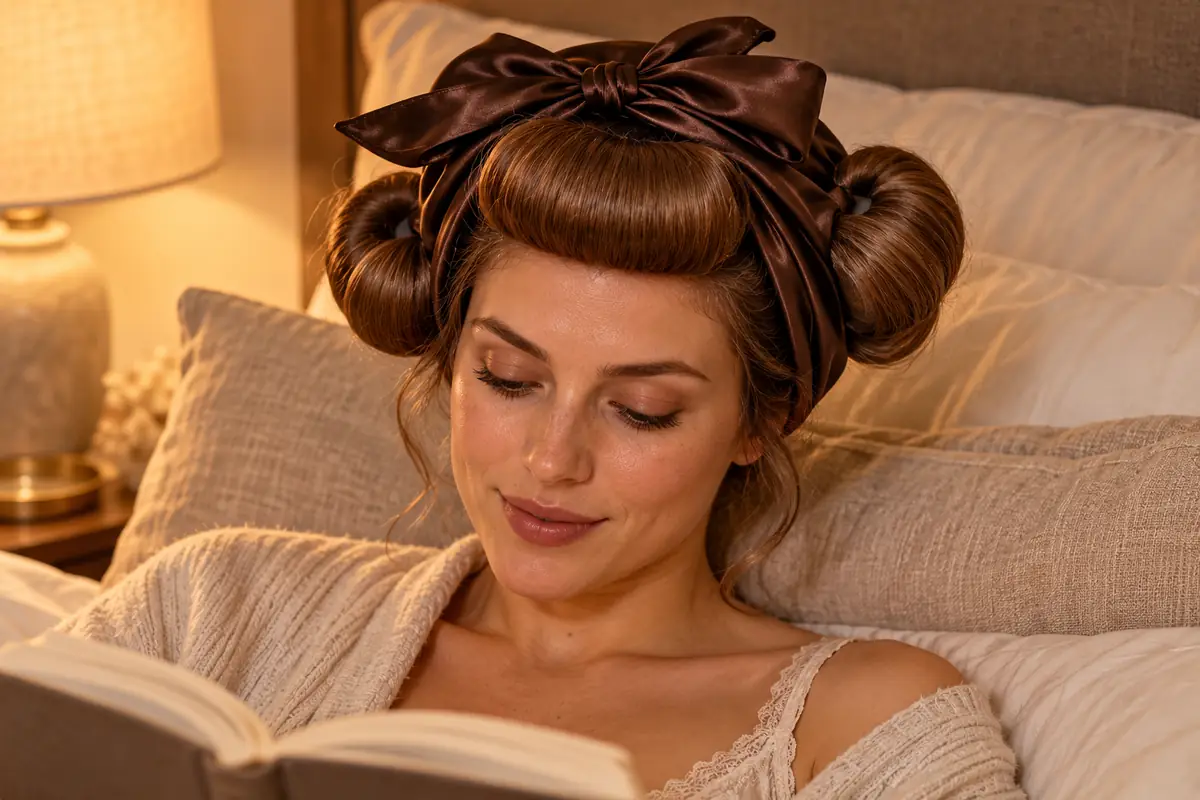
An overnight set is the easiest heatless routine there is: the styling happens while you sleep, and you wake up to soft, voluminous waves without any heat styling. What decides the result is not effort but three small details: how damp your hair is at bedtime, how long the set stays wrapped, and how gently you let it go in the morning.
This guide covers the night itself. If you have never wrapped a rod before, start with the step-by-step heatless curling rod tutorial, then come back here to make overnight heatless curls work for your hair.
Why heatless curls set while you sleep
A curl that holds is a shape your hair has dried into. Inside each strand, weak links called hydrogen bonds help keep the hair in whatever shape it is in. Water loosens those links, and as the hair dries they form again in the position the strand is held. Wrap a damp section around a rod, let it dry there, and the new bonds keep the curve after the rod comes out.
Hair scientists call this a cohesive set: a temporary change of shape made with water or heat, which depends on hydrogen bonds breaking and re-forming inside the fiber. A curling iron does it with heat; an overnight set does it with water and time, so the only thing working on your hair is the shape it dries in. The set is temporary for the same reason it works, because water undoes it as readily as it creates it.
Time in water that researchers treated as enough to relax the temporary, hydrogen-bond set of hair samples
That one mechanism explains the whole overnight routine. Your hair needs some moisture so the bonds can move, it needs to dry completely while it is still wrapped, and the finished waves need to stay away from water. A night gives the drying stage a generous window, and you spend it asleep instead of waiting.
Should you do heatless curls overnight on wet or dry hair?
The reason is how much water hair takes in, and how quickly it does so.
Water a fully hydrated hair can take in, relative to its own dry weight
Growth of a single hair’s diameter within 2.5 minutes of contact with water (its volume grew 31%)
Water gets in fast and in quantity, and every bit of it has to leave before the curl locks. Leaving is the slow part. In a dermatology lab study, hair tresses were tapped with a towel to remove the drops, then left to dry at room temperature:
Time a towel-blotted hair tress needed to dry completely at room temperature, 68 °F (20 °C)
That was a single tress, unwrapped and open to the room. A full head of hair, wrapped in layers around three rods under a scarf, has much more water to lose and far less surface open to the air. Start with dripping hair and the inner layers can still be damp at dawn, and a curl that is still damp relaxes the moment you unroll it.
| Hair at bedtime | What the night does | The squeeze test |
|---|---|---|
| Dripping wet | Dries slowly; the core may stay damp | Drops form |
| Damp | The sweet spot: sets and dries through | Cool, no drops |
| Dry | Sets too; mist any section that resists | Same from roots to ends |
Can you do heatless curls with wet hair?
Yes, as long as wet means damp. Squeeze a section in your fist: if water runs or drops form, give it more time in the towel or in the air before you wrap. The rule is the same for every heatless method, from sock curls to rods, because the chemistry is the same: the curl only locks once the water has gone. If you are weighing an overnight set against hot tools for the sake of your hair, see do heatless curls damage your hair.
Can you do heatless curls on freshly washed hair?
Yes, and it is the classic evening routine: wash, towel-dry gently, let the hair air-dry until it is only damp, then wrap. Long, thick hair holds the most water, so give it extra time before you start; for longer lengths, see heatless curlers for long hair. Shorter hair has less water to lose and is usually ready sooner; for shorter cuts, see heatless curls for short hair.
How long to leave heatless curls in
Leave the rods in until your hair is completely dry, all the way through. No single number of hours suits every head, because thickness, length and how damp you started all change it; the state of the hair matters more than the clock. The outside of each wrapped section dries first and the layers pressed against the rod dry last, so that is where to check. Slip a fingertip under the scarf and feel the innermost layer of your fullest section: cool or damp means it needs more time, dry means it is ready.
This is where overnight shines, because a night gives the drying stage a generous window:
Sleep per night recommended for adults aged 18 to 60
— American Academy of Sleep Medicine and Sleep Research Society, Sleep, 2015
Set that against the 2-plus hours a single lab tress needed to air-dry, and a full night is the relaxed choice for damp hair: the drying happens while you sleep, and you never have to unroll against the clock.
Is 2 hours enough for heatless curls?
It can be, on hair that starts dry or only lightly misted, because there is very little water left to evaporate. On damp hair, two hours may not be enough: a single towel-blotted tress needed longer than that in the lab, and wrapped hair has less surface open to the air than a single unwrapped tress. If a couple of hours is all you have, start dry.
How to curl your hair in 2 hours without heat
Start with dry, detangled hair and mist each section lightly just before you wrap it, so there is a little water to reset the bonds but not much to evaporate. Wrap snugly from the ends toward the roots, one rod on top and one on each side, and tie the scarf over them. Check the innermost layer before you unroll. When you have the whole evening, a full night on barely damp hair is the easiest combination, because the set gets all the time it needs to dry through.
How to sleep comfortably in heatless curls
Comfort is what makes an overnight set easy to repeat, and it starts with what your head rests on. Each rod in the overnight blowout rods set is soft enough to sleep on: a foam core under a velvet-soft cover, 10.6 in long and 1.4 in thick (27 × 3.5 cm). Once your hair is wrapped, the rods rest against your head, one on top and one on each side.
“works, is comfy and stayed on all night”— Verified buyer
The satin scarf goes over everything. It is a 27.5 × 27.5 in (70 × 70 cm) square in the same color as the rods, roomy enough to tie over all three rods at once and keep the whole set covered while you sleep. There is more on the scarf in the guide to the satin scarf for heatless curls, and cover fabrics are compared in satin vs velvet heatless curlers.
Back sleepers have the easiest night: the back of the head, where no rod sits, rests on the pillow. Side sleepers lie on one of the side rods, which is exactly where a soft foam core counts. Whichever way you sleep, a scarf tied smooth and flat is more comfortable than a bunched one, so smooth out any fold on the side you sleep on before you settle in.
Prefer a single piece? The heatless curling rod headband is one long 59 in (150 cm) rod worn over the crown like a headband, with each half of your hair wrapped around one side and held with one of the two matching scrunchies. The same damp, not dripping rule applies.
The morning release
The release decides how much of the night’s work you keep, so take it slowly.
- Check the innermost layer of your fullest section. If it still feels cool or damp, leave the rods in a little longer.
- Untie the scarf and set it aside.
- Unroll each section the opposite way to the wrap, letting the hair slide off the rod instead of pulling the rod out.
- Separate the waves with your fingers for more definition, or brush them through for a softer, fuller blowout finish.
“Looks like I just had my hair done when I take these out. Beautiful volume.”— Verified buyer
Why do my heatless curls not stay in?
After an overnight set, look at the release first. If the hair was still damp at the core, the bonds had not finished re-forming, so the curve relaxes as soon as it is released. Starting with dripping hair or wrapping loosely gives a weaker curl, and a steamy bathroom right after unrolling can relax it, since water is what loosens a set. Give the next night a damp rather than wet start and a snug wrap, and check the core before you unroll. For keeping waves from morning to evening, see how to make heatless curls last.
More overnight questions
What to put on hair before heatless curls?
Water is the one essential, because it is what lets the bonds reset around the rod. There is no single best product to set heatless curls overnight, and none is required. If your hair drops a curl easily, a light styling product worked through damp lengths before you wrap can add hold; keep the amount small so the waves stay soft and the covers stay clean.
Should I hairspray my heatless curls before bed?
You can, lightly, but you do not need to. The hold comes from the hair drying in shape rather than from the spray, and sprayed sections can be stiffer to wrap. If you like extra hold, save the mist for the morning, once the waves are shaped.
How do I keep my heatless curls all day?
Start with a complete set, dry to the core before you unroll. Touch the waves as little as you can and keep them away from steam and rain, since water relaxes a set. The full routine for all-day hold is in the guide to making heatless curls last.
Your overnight checklist
- Hair dry or damp at bedtime, never dripping.
- Three sections, one rod on top and one on each side, each wrapped snugly from the ends toward the roots.
- The satin scarf tied smooth over all three rods.
- A full night, then a fingertip check of the innermost layer.
- A slow unroll, then fingers for definition or a brush for a softer finish.
The tools for tonight come together in one heatless curling rod set: three soft rods and a satin scarf in the same color, eight colors to choose from, and a photo guide tucked in the box.