
· Maren Alcott
Satin vs Velvet Heatless Curlers, Plus Silk: Which Fabric Holds a Curl?
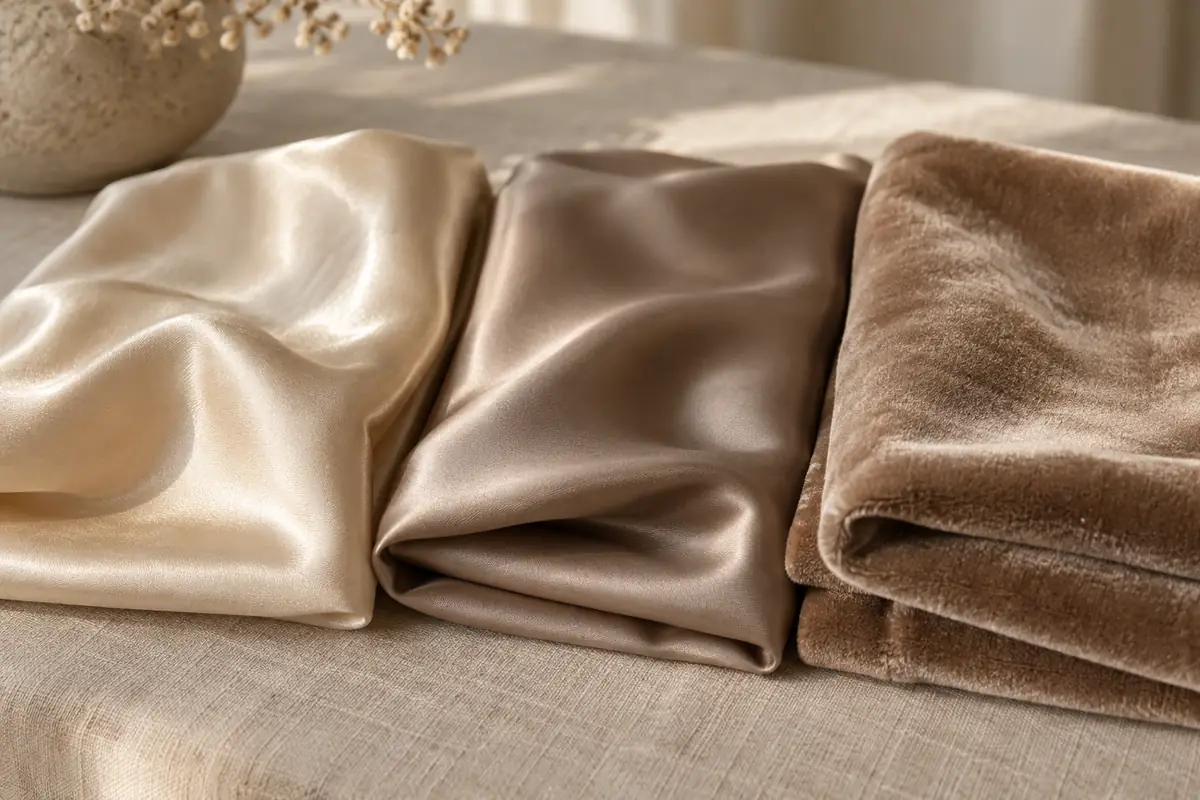
Shop for heatless curlers and three words keep coming back: silk, satin and velvet. They sound like three grades of the same thing, yet they describe different things entirely. Silk is a fiber, satin is a way of weaving yarn, and velvet is a fabric with a raised pile. That difference decides whether a strand stays coiled on the rod all night or slides loose before morning.
This guide compares the three by category, using what textile and hair researchers have published: how each surface feels to a strand, what it means for frizz and friction, how it holds through the night, and how to care for it. It ends with why the Lunelock heatless curling rod set pairs velvet-soft rods with a satin scarf. For the wrapping steps themselves, see the heatless curling rod tutorial.
Silk, satin and velvet: a fiber, a weave and a pile
The three names answer three different questions. Silk tells you what the yarn is made of. Satin tells you how the yarns cross each other. Velvet tells you what the surface looks like up close. That is why one fabric can carry two of the names at once, and why the label on a curler only tells half the story.
Silk: a natural protein fiber
Silk is a natural, protein-based fiber spun by silkworms, most often the larvae of the Bombyx mori moth, as the Textile Research Lab at Pratt Institute describes it, and it is prized for its luxurious texture and sheen. Each silk filament is a core of a protein called fibroin, coated with adhesive proteins called sericins.
Share of a silkworm cocoon’s weight made up of sericin, the adhesive protein that coats silk’s fibroin core
Because silk is a fiber, it can be woven into a glossy satin or cut into the pile of a velvet. A “silk heatless curler” therefore names the fiber, not the surface your hair will actually touch.
Satin: a weave, not a material
Satin names a structure. In a satin weave, each warp thread floats over a run of weft threads before a single thread ties it down. Those long floats give satin its smooth, glossy face and its dull back, and they reflect light evenly, which is where the shine comes from.
Weft threads each warp thread passes over in a satin weave before one thread ties it down: the long floats behind satin’s smooth, glossy face
The same weave can be made from filament fibers such as silk, polyester or nylon. So “silk vs satin” compares a fiber with a weave. Silk satin and polyester satin share the same smooth, floating face; what changes is the fiber underneath. Pratt’s lab describes polyester as a synthetic fiber that is quick-drying and easy to care for.
Velvet: a pile fabric
Velvet is defined by its surface. It is a woven fabric with a dense, even pile, and today it can be made from silk, cotton, wool or synthetic fibers. Pratt’s lab describes a pile as loops or cut threads that stand upright from the base fabric to create a soft, plush surface; when those loops are cut, the result is velvet. That plush, upright texture is what your hair meets on a velvet-covered rod.
Slip vs grip: what each surface does to a curl
A heatless curl forms while your hair dries wrapped around a rod, so each strand has to stay where you put it until morning. Two things keep it there: how snugly you wrap, and how well the rod’s surface holds the hair.
Satin and silk are made to glide. Their smooth, even faces let a strand slide across easily, which feels lovely against your cheek and helps a lot less under a section that needs to stay coiled while you turn over in your sleep. Velvet’s pile works the other way: the upright fibers catch the hair lightly, so a wrapped section keeps its place without being pulled tight.
Hair scientists measure that hold as friction. In one lab test, a single strand was wrapped around a smooth polyamide cylinder, the plastic many combs are made of, and slid along it, dry and then wet.
Friction coefficient of a single human hair sliding on a smooth polyamide cylinder, dry versus wet
Wet hair nearly doubled its friction, because water increases the real contact area between the hair and the surface. For heatless curls, that means barely damp hair brings some grip of its own, while dry, freshly washed hair leans on the rod’s surface. That is exactly when a slippery cover gives a strand the least to hold on to, and when a velvet-soft cover earns its place.
Hold through the night comes from the same grip. Once a section is wrapped from the ends toward the roots and the rod rests against your head, the soft pile keeps the coil from unwinding as you move, and the satin scarf tied over the rods keeps the whole set in place. Buyers put it simply:
“works, is comfy and stayed on all night”Verified buyer
Frizz and friction: what your hair’s cuticle feels
Smooth, glossy waves start at the surface of each hair. Its outer layer, the cuticle, is made of flat, overlapping scales laid like shingles on a roof, and the shape and direction of those scales make hair’s friction depend on which way it is rubbed.
Layers of overlapping cuticle scales on Asian hair, with slightly fewer on Caucasian hair and fewer again on African hair
The same review names attrition, the gradual wearing of the hair’s surface, as the main cause of frizz. At night, the everyday version is rubbing: loose lengths dragging across a pillowcase each time you turn, and strands brushing against one another. That friction happens on the outside of a heatless set, where your hair meets the pillow.
On the rod, a snugly wrapped section barely moves, so a velvet-soft cover holds the curl without rubbing it. Around the set, a smooth satin layer lets your head move on the pillow while the hair underneath stays still. And since damp hair has the most friction, the time while the set dries is when that smooth outer layer matters most. Grip where the curl forms, glide where the pillow is: that is the whole logic of pairing fabrics.
Silk vs satin vs velvet heatless curlers at a glance
Here is how the three compare on the points that shape a heatless set, from what each one is to where it works best.
| Point | Silk | Satin | Velvet |
|---|---|---|---|
| What it is | A natural protein fiber | A weave with long floats | A fabric with a short, dense pile |
| Made from | Silkworm filament | Silk, polyester or nylon filament | Silk, cotton, wool or synthetic fibers |
| Surface | Smooth, with a natural sheen | Glossy face, dull back | Soft, downy, textured |
| What a strand does | Slides easily | Slides easily | Stays where you wrap it |
| Best job in a heatless set | Outer layer, against the pillow | Outer layer: the scarf over the rods | The rod cover, under the hair |
| Care | Gentle hand-wash, air-dry | Keep away from snags | Store without crushing the pile |
Silk here means a smooth silk weave. Silk woven as velvet behaves like velvet, because the surface, not the fiber, decides how a strand sits.
Is satin or velvet better for heatless curlers?
A satin-covered rod feels smooth and looks glossy, and the same slip that makes satin so pleasant on the outside works against it under a strand. In the lab test above, dry hair had about half the friction of wet hair, so a dry section on a slippery cover is the one most likely to slide loose. A velvet-soft pile gives it something to hold.
Is silk or velvet better for heatless curls?
Velvet, for the same reason. Silk is prized for its smooth texture and sheen, which is exactly why it glides. That glide belongs on the layer your pillow touches, not on the surface your curl depends on. If you already sleep on silk, it pairs well with a velvet-soft set: the rods hold the curl, and your pillowcase glides.
Silk vs satin heatless curls: is there a difference?
For the curl, very little. Silk satin and polyester satin share the satin weave, so both present the same smooth, floating face to your hair. The difference is the fiber underneath: silk is a natural protein fiber, polyester a synthetic one that dries quickly and is easy to care for. Choose between them for feel and care; for grip, both are satin.
How to use velvet, satin and silk heatless curlers
How to do velvet heatless curls
- Start with dry or barely damp hair, combed through with no knots.
- Take a section and wrap it around the rod like a big roller, from the ends toward the roots.
- Keep each rod against your head: the first on top, the second on one side, the third on the other.
- Tie the satin scarf over the rods, then go to sleep.
- In the morning, unroll gently and shake out big, voluminous, blowout-style waves.
For more defined waves, hold a rod upright and wrap a section in a spiral along its length. The full walkthrough is in the heatless curling rod tutorial, and the night itself is covered in heatless curls overnight.
How do I use a satin heatless curler?
The method is the same, with two adjustments for a slippery surface. Roll hair that is barely damp rather than bone-dry, since damp hair grips more, and lay the ends flat and snug against the rod before you roll upward. Then tie a scarf over the finished set so the rods stay put while you sleep.
How to do heatless curls with silk
Use silk where it glides: as the pillowcase under your set or a smooth wrap over it. Wrap your hair around velvet-soft rods as above, then cover the set. If a rod has a silk cover, follow the satin steps: barely damp hair, snug wraps and a covered set.
Caring for silk, satin and velvet
Each fabric keeps its surface best with a little care, and the surface is what your hair feels.
- Silk: a natural protein fiber, so treat it gently. Wash it by hand in cool water with a mild detergent, skip the wringing and let it air-dry.
- Satin: the long floats that make it smooth can snag easily, so keep it away from rough edges, rings and zippers. Polyester satin dries quickly and is easy to care for.
- Velvet: the pile is what gives it grip, so store velvet pieces loose rather than squashed under something heavy.
- All three: heavy oils and rich creams transfer onto fabric. Roll clean, product-light hair, and save the oil for your ends after you unroll.
Why the Lunelock set pairs velvet-soft rods with a satin scarf
The Lunelock heatless curling rod set puts each fabric where it does the most for your curls. Three rods, each 10.6 in long and 1.4 in thick (27 × 3.5 cm), have a foam core under a velvet-soft cover that holds each wrapped section while it dries into big, voluminous waves. One satin scarf, a 27.5 × 27.5 in (70 × 70 cm) square, ties over all three rods and gives the pillow a smooth surface to meet.
The rods and the scarf come in the same color, in eight shades: Coffee, Black, Khaki, Pink, Wine, Navy, Beige and Sky Blue. A photo guide is tucked into the box, and every order ships free with 30 days to change your mind. It is the same routine people mean by overnight blowout rods, and it suits long hair as well as shorter cuts. For ways to tie the scarf, see the satin scarf guide for heatless curls.
“They work perfectly, beautiful bouncy curls as expected”Verified buyer
Prefer one piece? The Lunelock Classic Curling Rod applies the same idea to a 59 in (150 cm) rod you wear like a headband: a foam core under a velvet-soft cover, with flat ribbon ends that tie in a bow on top of your head, for soft waves along the whole length. Two matching scrunchies come with it.
“High quality, good grip, looks good and luxurious and I can't recommend of this item enough for heatless looks”Verified buyer
More questions about heatless curler fabrics
What is the best silk heatless curler?
Silk’s strength is glide, and glide is what you want on the outside of a set. For the rod itself, look for a cover that holds the strand, a thickness that matches the waves you want, and a shape comfortable enough to sleep on. Then add smoothness on top, where silk and satin shine.
What is the most effective heatless curler?
The one that stays put all night and matches the curl you want. Thickness sets the size of the wave: a 1.4 in (3.5 cm) rod makes big, blowout-style waves, while a long headband-style rod gives soft waves along the length. After that, look at the cover, comfort for sleep and a smooth layer on top. Weighing a rod against socks? See sock curls vs a heatless curling rod.
What is the most effective way to do heatless curls?
Overnight, on dry or barely damp hair, wrapped from the ends toward the roots and covered with a satin layer. The set needs to dry completely before you unroll it, and a night gives it that time. The guide to making heatless curls last covers the morning after.
Which fabric keeps heatless curls smoothest overnight?
Two fabrics, each in its own place. On the rod, a velvet-soft cover keeps each section from sliding loose while it dries. Over the set, satin gives the pillow a smooth surface, so loose lengths glide instead of rubbing, and rubbing is the attrition that roughens the cuticle into frizz. For the hair-health side, read do heatless curls damage your hair, and buyers’ own words are on the reviews page.