
Overnight Blowout Rods for a Heatless Blowout While You Sleep
You go to bed with three soft rolls tucked under a satin scarf, and you unroll big, voluminous waves in the morning, the blowout look without a dryer, a round brush or any hot tool. What follows: what an overnight blowout is, why the thickness of the rod decides the result, exactly where the three rolls go, and how to finish the look once they come out. For the full wrapping tutorial, see how to use a heatless curling rod.
What an overnight blowout is
A salon blowout is a shape, not a curl. The stylist pulls each section over a big round brush while the dryer sets it, so the hair falls smooth and glossy, the roots stand up from the scalp, and the ends turn into a soft bend. The look is body and movement, the kind of hair that swings when you turn your head.
An overnight blowout, or heatless blowout, builds the same shape with time instead of heat. You wrap your hair around a wide, padded rod while it is dry or barely damp, keep it there while you sleep, and let the hair settle into the curve of the rod. When you unroll in the morning, the hair keeps that wide curve as big, voluminous waves. Blowout rods are simply rods built for that job, thick enough to give a bend instead of a spiral and soft enough to sleep on.
If you want a closer look at the bedtime side of it, including timing and what to put on your hair first, the guide to heatless curls overnight goes step by step.
Why 1.4-inch rods give volume instead of tight curls
The diameter of whatever you wrap your hair around decides the diameter of the curl you get back. Wrap a strand around a pencil and you get a ringlet; wrap it around a wide can and you get a gentle wave. Blowout rods sit firmly on the wide side of that scale.
Each rod in the Lunelock set is 10.6 in long and 1.4 in thick (27 × 3.5 cm), with a foam core and a velvet-soft cover. A little arithmetic shows what that thickness does: one trip around a 1.4-inch cylinder uses about 4.4 inches of hair (π × 1.4). Even long strands make only a few turns around the rod, so the hair comes off in a few big, open bends instead of many tight coils. That is what reads as volume rather than curls.
The second factor is where the rod ends up. You roll from the ends toward your head, so the finished roll rests against your scalp and the wave starts high on the head instead of halfway down the lengths. The foam is semi-rigid: it keeps a round shape for the hair to wrap around, and the velvet-soft cover makes it pleasant to lie on.
Here is how the three common ways of setting hair without heat compare:
| Method | What you wake up with | How it sits on your head | Suits |
|---|---|---|---|
| Jumbo blowout rods (1.4 in) | Big, voluminous waves: the blowout shape | Three padded rolls, one on top and one on each side, under a satin scarf | Shoulder-length to very long hair that wants body and bounce |
| Smaller rollers | More, tighter curls with a defined pattern | Many small rollers across the head, each pinned or fastened | Anyone after curls rather than a blowout finish |
| Sock method | Waves whose size depends on how the sock is rolled and how much it is stretched | One rolled sock worn across the crown, hair wrapped around it | Anyone who prefers one roll across the crown to three separate sections |
The sock trick and the rod set are compared in detail in sock curls vs a heatless curling rod.
The three-roll placement, step by step
The set comes with a photo guide in the box, and the method is the same every night: three sections, three rods, one scarf.
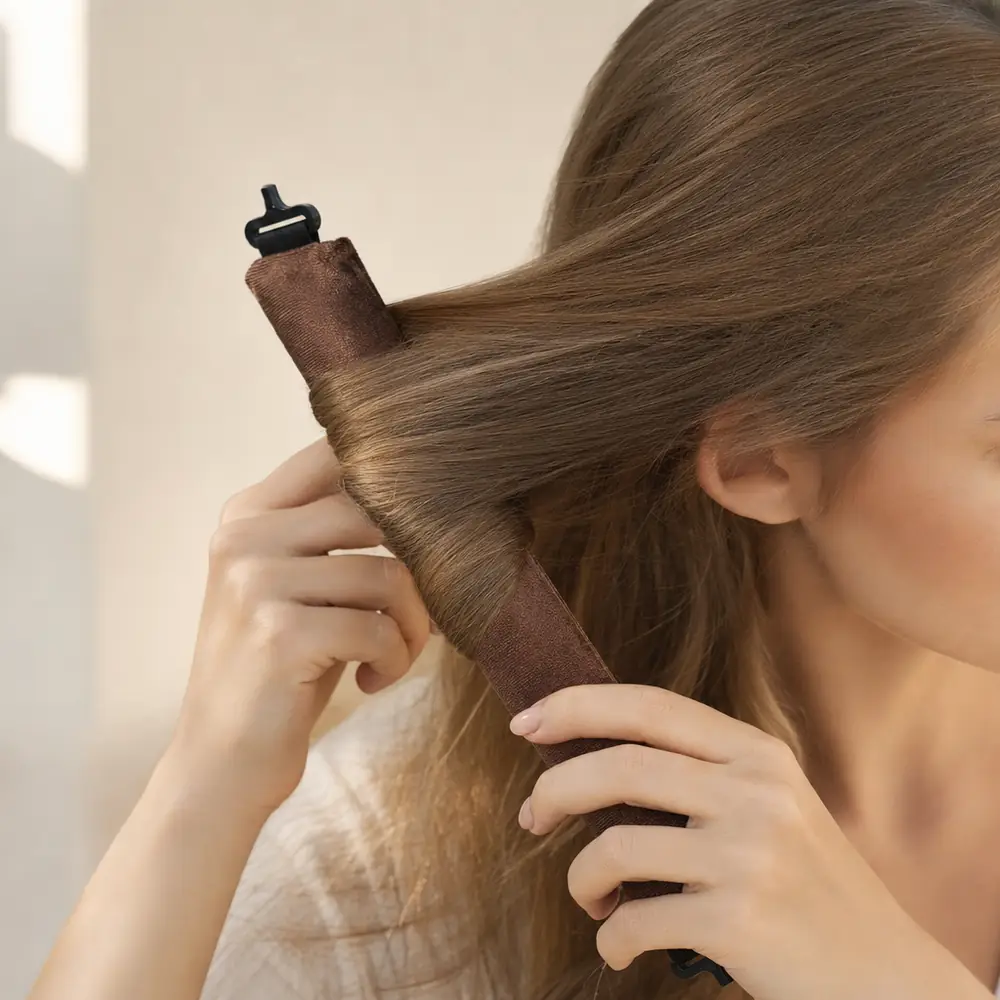
- Start dry or barely damp. Brush out knots and smooth the hair in the direction you want it to fall.
- Top roll. Take a section from your hairline back over the crown. Lay the first rod across the ends and roll the hair around it toward your head, like a big roller, until the rod rests on top of your head.
- Left side roll. Take the hair on the left side, from the temple back to behind the ear. Roll it from the ends up in the same way until the second rod sits against the side of your head.
- Right side roll. Repeat with the third rod on the right side, so the two sides mirror each other.
- Tie the scarf. Lay the 27.5 × 27.5 in (70 × 70 cm) satin scarf over the three rolls and tie it on top, so your pillow touches smooth satin instead of the rolls.
- Sleep. In the morning, make sure every section feels completely dry before you unroll.
The direction you roll the side sections, toward your face or away from it, decides which way the waves fall around your face. If you prefer more defined waves over a blowout finish, you can also spiral a section down the length of a rod held upright, as in the photo above.
Why the placement matters for sleep: most of the night is spent on your side, which means your head rests on one of the side rolls for hours.
Share of their time in bed that 664 working adults spent lying on their side, in a study that tracked sleep positions with body-worn accelerometers.
That is where a foam core under a velvet-soft cover matters, with the satin scarf over everything. Buyers mention the comfort:
“works, is comfy and stayed on all night”— Verified buyer
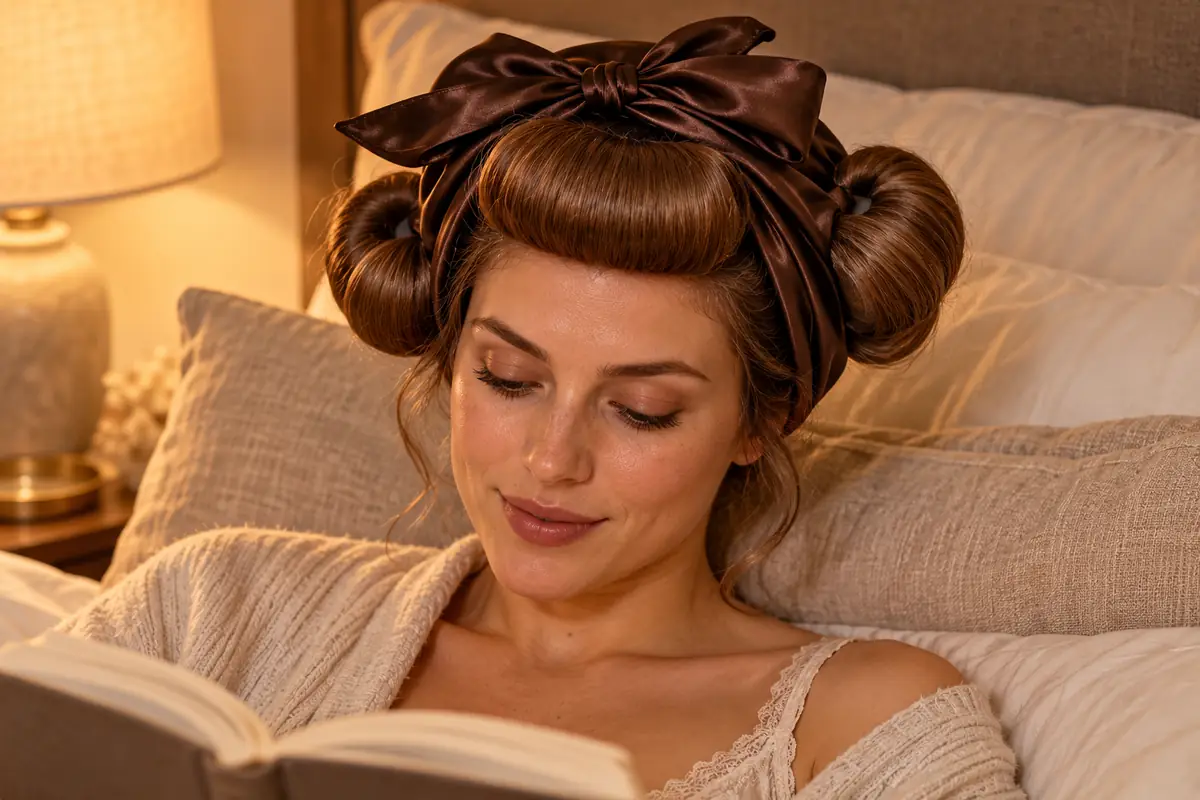
The first night can feel new. One buyer put it this way:
“I have to use it more often to get used to it. But you sleep with them comfortably.”— Verified buyer
How to finish your overnight blowout in the morning
The finish is where a set turns into a blowout:
- Unroll slowly. Untie the scarf, then let each roll unwind by turning the rod backward instead of pulling it out, so the bend stays intact.
- Finger-comb, don't brush. Slide your fingers through from underneath to break the three big rolls into softer, blended movement. A brush straight through will pull the shape flat.
- Flip the ends. Decide on the finish: turn the ends under with your fingers for a classic, polished blowout, or push them outward for a 90s-style flip.
- Lift the crown. Tip your head forward, shake the roots gently with your fingertips, then flip back to loosen the top section.
- Set it lightly. A small amount of a light-hold product on your palms, smoothed over the surface, keeps flyaways down without weighing the volume.
“Just like the photo, it makes very pretty waves.”— Verified buyer
Who an overnight blowout suits: the hair length logic
Because one turn around a 1.4-inch rod takes roughly 4.4 inches of hair, length decides how much of a roll you get. Think of it in three bands.
Shoulder length and longer. This is where blowout rods shine. There is enough hair for at least one or two full turns on each rod, so every section comes out with a clear, wide wave. The longer the hair, the more turns it makes around the rod.
Very long hair. More length means more hair stacked on each rod, so the rolls get bigger. Keep the sections even so all three rolls finish the same size. The dedicated page on heatless curlers for long hair covers waist-length sectioning.
Chin length and shorter. With less hair to go around the rod, you get fewer turns, so expect a softer bend rather than a full roll. Smaller sections help. The guide to heatless curls for short hair shows the adjustments.
Fine hair is welcome too. One buyer wrote:
“They seemed to work pretty good on my thin hair. Glad a bought them!”— Verified buyer
If you would rather wear one long rod over the crown like a headband and wrap each side around it, that is a different format with its own look: see the heatless curling rod headband.
A blowout without the blow-dryer
A classic blowout takes a hot dryer and often a curling iron for the ends. The American Academy of Dermatology advises letting hair partially air-dry before styling and cutting down how often you blow-dry, and it is just as direct about irons:
The most the AAD suggests leaving a curling iron in place, noting that excessive heat can damage any hair type.
— American Academy of Dermatology, 2026
An overnight blowout is no heat styling, so no heat on your hair: the shape comes from the rod and the hours you spend asleep. For the broader picture on setting hair without heat, read do heatless curls damage your hair.
Keeping the volume all day
A set made without chemicals lives in the temporary hydrogen bonds inside each hair. Those bonds form as the hair dries in its new shape, and water undoes them. Lab researchers rely on this when they want to erase a temporary set from hair samples:
Time in water that researchers treated as enough to relax the temporary, hydrogen-bond set of hair samples
In practice, that means three things. Make sure the hair is completely dry before you unroll. On humid days, a light-hold product can help, since moisture in the air is water too. And at night, re-roll the top section or tie the scarf loosely to protect the bend for day two. One buyer describes it this way:
“These are great for heartless curls. Keeps my hair looking great all week when I use these. Looks like I just had my hair done when I take these out. Beautiful volume. I would definitely repurchase. I keep a set at home and a set in my travel bag.”— Verified buyer
More day-two and day-three tricks are in how to make heatless curls last.
What comes in the set
Every Lunelock Overnight Blowout Rod Set holds three rods and one satin scarf in the same color, in a choice of eight: Coffee, Black, Khaki, Pink, Wine, Navy, Beige and Sky Blue.
- Three jumbo rods. Each one is 10.6 in long and 1.4 in thick (27 × 3.5 cm), with a semi-rigid foam core and a velvet-soft cover. A short black elastic tab sits at each end, with a small T-shaped plastic hook at the top and a keyhole-shaped plastic loop at the bottom.
- One square satin scarf. It measures 27.5 × 27.5 in (70 × 70 cm), enough to cover all three rolls and tie on top. The guide to the satin scarf for heatless curls shows other ways to tie it.
- A photo guide. Picture-by-picture instructions for the three-roll method come in the box.
Curious how the cover compares with other fabrics? The satin vs velvet heatless curlers guide walks through feel and grip. For the whole set in one place, visit the Lunelock heatless curling rod set page.
“They work perfectly, beautiful bouncy curls as expected”— Verified buyer
Overnight blowout rods: your questions
What makes overnight blowout rods a good choice for volume?
Their thickness. Each Lunelock rod is 1.4 in (3.5 cm) across, so every strand wraps around a wide cylinder instead of a narrow one. A wide cylinder gives the hair a few big, open bends rather than tight ringlets, which is why you unroll to large, voluminous blowout-style waves, made with no heat.
How long should you leave overnight blowout rods in?
Leave them in until every section is completely dry. A full night makes that easy, which is the whole idea of an overnight blowout: you set the three rolls before bed, sleep, and take them out in the morning. If any hair still feels cool or damp when you unroll, the shape will soften faster, so give it longer next time.
How do you do an overnight blowout with rods?
Start with dry or barely damp hair. Take the top section, lay a rod at the ends and roll the hair around it toward the root, like a big roller, until the rod rests against your head. Do the same on the left side and the right side, tie the satin scarf over all three, and sleep. In the morning, unroll gently, finger-comb and flip the ends.
Can you do an overnight blowout on wet hair?
Dry or barely damp hair is the best starting point. Hair that is still dripping sits inside a thick roll with little air around it and may not be dry by morning, and hair that is not fully dry lets the shape relax. Towel-dry well, let it air-dry most of the way, then roll.