
· Maren Alcott
Sock Curls vs. Heatless Curling Rods: How the Two Methods Compare
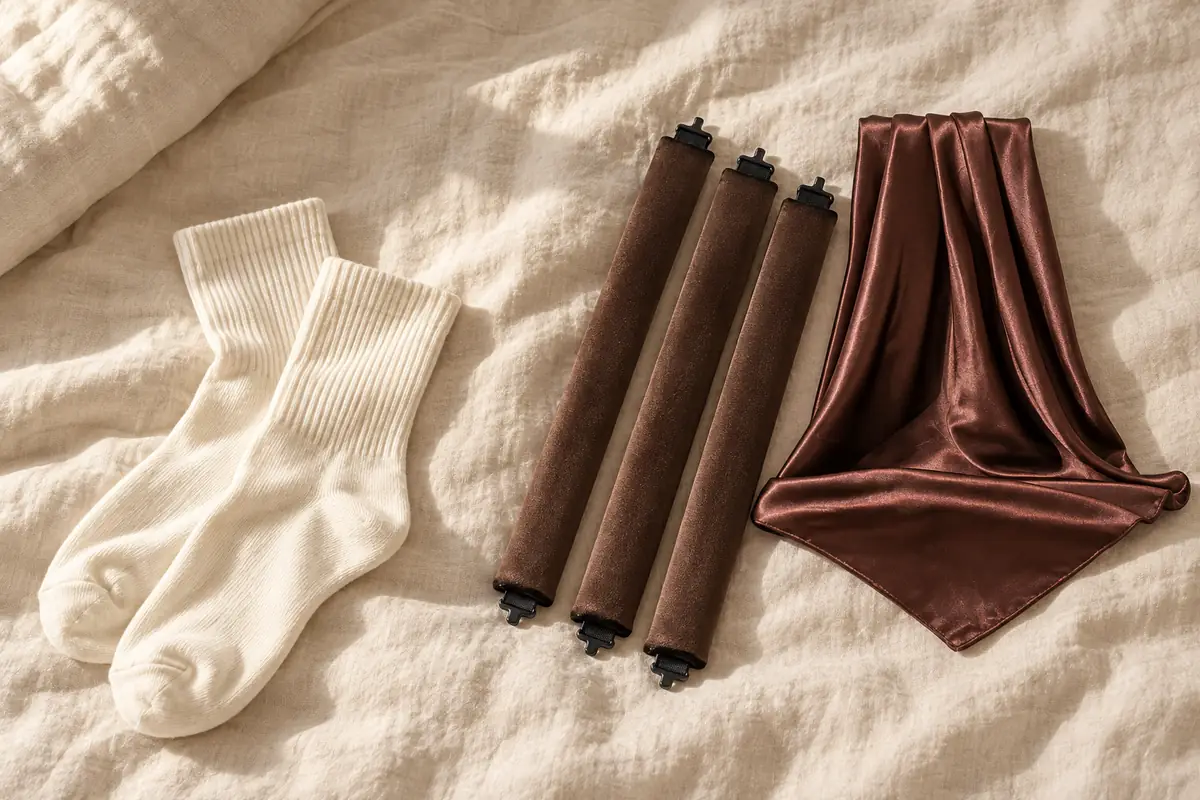
Sock curls are one of the best-known heatless tricks: a clean sock, a high ponytail and a night’s sleep, and you wake up to curls without any heat styling. The idea behind them is sound, and it is the idea behind every heatless set. Water breaks hydrogen bonds in the keratin of your hair, as happens in a regular blow-dry, a point a 2015 review of hair cosmetics makes. Hair that then dries wrapped around a shape keeps that shape when you unwind it. Both methods leave heat out of the picture entirely; for the longer story on heat and hair, read do heatless curls damage your hair.
So the real question is what your hair dries around. This guide shows how to do sock curls, then puts a rolled sock side by side with the Lunelock Overnight Blowout Rod Set on everything you notice in the morning: the shape of the waves, how the roll holds, how much of your head it covers, how you sleep on it, and whether you get the same result the next time.
How to do sock curls
There are a few versions of heatless curls with socks. The best known uses a single clean crew sock and one high ponytail:
- Start with detangled hair that is dry or barely damp.
- Gather your hair into a high ponytail on top of your head and tie it with a soft hair tie.
- Lay the sock across the ends of the ponytail. Some people cut off the toe and roll the sock into a ring first, then thread the ponytail through it, the way you would for a sock bun.
- Wind the ends around the sock and keep rolling down toward your scalp, tucking the hair in as you go, until the sock sits as a bun on top of your head.
- Knot the two ends of the sock over the bun, or pin the bun in place with bobby pins.
- Sleep, then unroll the sock in the morning, take out the hair tie and separate the curls with your fingers.
Another version drapes a long sock over the top of your head like a headband and wraps each half of your hair around one side of it. Either way, the principle is the one described above: your hair dries in the shape of the sock.
Do you do sock curls wet or dry?
Dry or barely damp, never dripping. The curl only sets once the water has left the hair, and hair wound thickly around a sock dries from the outside in, so the innermost layer takes longest. Wet hair also stretches under tension, which matters when your whole head of hair is pulled into one ponytail and wound snug:
How far wet hair that has never been chemically treated can stretch without damage. Stretched between 30% and 70%, it changes irreversibly.
Keep the tension snug rather than tight, whatever you wind your hair around. The full wet, damp or dry comparison lives in heatless curls overnight.
Can I do sock curls in 2 hours?
The shorter the night, the drier your hair should be when you start: dry or lightly misted hair has little water left to lose, while damp hair needs longer than most people expect. In a dermatology lab study, hair samples were tapped with a towel to remove the drops and left to dry in the open air:
Time a single towel-blotted hair tress needed to dry completely at room temperature, 68 °F (20 °C)
That was one open tress. A whole ponytail wound into one bun has far more hair between its innermost layer and the air, which is why sock curls, like any heatless set, are easiest overnight: the drying happens while you sleep.
What do sock curls look like the next morning?
Curly, with most of the movement in the lengths and ends. Because all your hair is wound around one sock on top of your head, the curl starts where the ponytail ends: the hair between your scalp and the hair tie is not wound around anything, and the tie can leave a bend where it held the ponytail. Hair rolled over a thick fold of the sock and hair rolled over a single layer of knit also come out as slightly different curls. Plenty of people enjoy that relaxed finish. If the look you picture is a smooth, full blowout, the comparison below is for you.
Sock curls vs. a heatless curling rod, side by side
Both methods set your hair while you sleep. What changes is the object your hair dries around, and how it sits on your head.
| What you compare | Sock curls | Lunelock rod set |
|---|---|---|
| What your hair wraps around | One rolled or knotted cotton sock | Three straight foam rods, each 10.6 in (27 cm) long |
| Shape | Changes with the sock and the way you roll it; thicker at folds and at the knot | The same 1.4 in (3.5 cm) thickness along the rod, every night |
| Surface under your hair | Cotton knit: ribbed cuff, heel pocket, toe seam | A velvet-soft cover along the whole rod |
| Coverage | Your whole head in one ponytail, one bun | Three sections, three rolls: top, left side, right side |
| Kept in place by | A knot in the sock or bobby pins | A matching 27.5 × 27.5 in (70 × 70 cm) satin scarf tied over all three rolls |
| Sleeping | One bun in one spot on top of your head | Three covered rolls lying close to your head, under the scarf |
| Night after night | Depends on which sock you pick and how it was rolled | Same rods, same method, photo guide in the box |
| The look | Curls in the lengths and ends, below the ponytail | Big, voluminous blowout waves, plus a spiral option for more defined waves |
Shape: a rolled sock vs. a straight 1.4 in rod
A curl takes the shape of whatever it dries around, so that object decides the shape of your wave. A sock was made for a foot. Rolled or knotted, it is thicker where the fabric folds over itself and at the knot, softer where it is a single layer of knit, and it gives a little under the weight of the hair wound around it. Roll it slightly differently tomorrow and your hair dries around a different shape.
Each Lunelock rod is a straight foam rod, 10.6 in (27 cm) long and 1.4 in (3.5 cm) thick, so every turn of hair wraps around the same curve. The section you roll on the left dries around the same thickness as the one on the right and the one on top, which is what keeps the waves even. At each end, a rod has a short black elastic tab, finished with a small T-shaped plastic hook at the top and a keyhole-shaped plastic loop at the bottom.
Grip and slip: cotton knit vs. a velvet-soft cover
What sits directly under your hair all night matters too. A crew sock is a cotton knit, and its surface changes along its length: a ribbed cuff, a smoother foot, a heel pocket and a seam across the toe. Hair wound around it meets a different texture at almost every point, and the roll stays put only where you knot the sock or pin it.
Each rod carries a velvet-soft cover over its foam core, so every strand rests on the same soft surface from one end of the rod to the other. Once all three rolls are in, the matching satin scarf ties over them, keeps them against your head and stands between your hair and the pillowcase. That last part counts: the same 2015 review names attrition, the wear that comes from rubbing, as the main cause of frizz. For a closer look at cover fabrics, see satin vs. velvet heatless curlers; the scarf has its own guide, satin scarf for heatless curls.
Coverage: one sock bun vs. three rolls
A sock bun gathers your whole head of hair into one ponytail and winds it around one sock. That has two consequences. The bun holds a lot of hair in one place, so the layers pile up thick and the innermost ones sit far from the air. And every strand has to travel to the same point on top of your head, including the shorter layers around your face, which can slip out of a single high ponytail.
The rod set splits your hair into three sections, one per rod: the first on top of your head, the second on one side, the third on the other. Each rod carries one section instead of your whole head of hair, and each one is rolled up until it rests against your head, including at the sides of your face. If your hair falls well past your shoulders, read heatless curlers for long hair; for shorter cuts, heatless curls for short hair is the guide to follow.
Sleeping on it: one bun or three soft rolls
Whatever you wear to bed has to stay comfortable, and stay in place, through a whole night of turning over. Adults spend most of their time in bed on their side:
Share of their time in bed that 664 working adults spent lying on their side, in a study that tracked sleep positions with body-worn accelerometers.
And they move more than they think:
Position shifts per hour in bed, on average, among the same 664 adults.
A sock bun sits in one spot on top of your head, held by its own knot or a few pins, so how it feels depends on where you placed the ponytail and which way you sleep. With the rod set, the three rolls lie close to your head, one on top and one on each side, each with a foam core under its velvet-soft cover, and the scarf ties over all three. When you turn onto your side, what rests on the pillow is a roll wrapped in a velvet-soft cover and satin.
“works, is comfy and stayed on all night”
Verified buyer
Night after night: the same result again
The best heatless routine is one you can repeat on a busy evening and get the same result. With a sock, every variable moves: the sock itself, with its own thickness, length and stretch, how firmly you rolled it, and where the knot ended up. A change in any of them shows up in the curl the next morning.
The rod set takes those variables away. The three rods are the same every night, the method is the same (three sections, each rolled from the tips to the scalp, then the scarf), and a photo guide comes in the box, so the steps are with you at bedtime. The rods and the scarf come in the same color, in Coffee, Black, Khaki, Pink, Wine, Navy, Beige or Sky Blue.
“I keep a set at home and a set in my travel bag.”
Verified buyer
If rods are new to you, the step-by-step heatless curling rod tutorial walks you through the first night, and how to make heatless curls last covers the day after.
The look: curls vs. blowout waves
The two methods also give two different finishes. Sock curls give curls: bouncy movement in the lengths and ends, below the point where the ponytail was tied. The rod set gives a blowout. Because each section is rolled from the tips to the scalp like a big roller, and each rod rests against your head, you wake up to big, voluminous waves, the look behind the name overnight blowout rods.
On the days you want more definition, the same rods give you a second look: wind a section in a spiral down a rod held upright, for more defined waves. The heatless curling rod tutorial covers both methods, step by step.
“Just like the photo, it makes very pretty waves.”
Verified buyer
Which should you choose?
Sock curls show how simple heatless styling can be: hair that is dry or barely damp, a shape to dry around and a night’s sleep. When you want that night to end in a blowout that comes out the same way every time, choose the rod set, for five concrete reasons:
- Even waves on every section. Each rod is straight and 1.4 in (3.5 cm) thick, so every turn of hair dries around the same curve.
- A soft, even surface under your hair. One velvet-soft cover runs over the foam core from end to end.
- Your whole head styled. Three rolls cover the top and both sides, each one rolled up until it rests against your head.
- A comfortable night. Three covered rolls lie close to your head, with a matching 27.5 × 27.5 in (70 × 70 cm) satin scarf tied over them.
- The same result, night after night. The same three rods, the same method, and a photo guide in the box.
If the headband version of sock curls is the one you like, the Lunelock Classic Curling Rod is made for exactly that: one long foam rod under a velvet-soft cover, 59 in (150 cm) end to end, worn over the middle of your head like a headband. You wrap each half of your hair around its side, finish each end with one of the two matching scrunchies or knot the flat ribbon ends, sleep, then unwind soft waves through the lengths.
Ready for your first night with the heatless curling rod set? Choose your color below: three rods and a satin scarf in the same color, with the photo guide tucked in the box.