
Heatless Curlers for Long Hair: Big, Even Waves Overnight
Long hair has the length to carry several waves from crown to tips, and a thick rod turns that length into big, bouncy volume instead of tight ringlets. The set holds three velvet-soft rods and a 27.5 in (70 cm) square satin scarf in the same color, and it sets your hair while you sleep, with no heat on your hair at all. Below, you’ll find how to section long lengths, how much hair one rod takes, how to roll evenly and avoid dents, and how to finish the waves in the morning. If you are brand new to rods, start with the step-by-step guide to using a heatless curling rod.
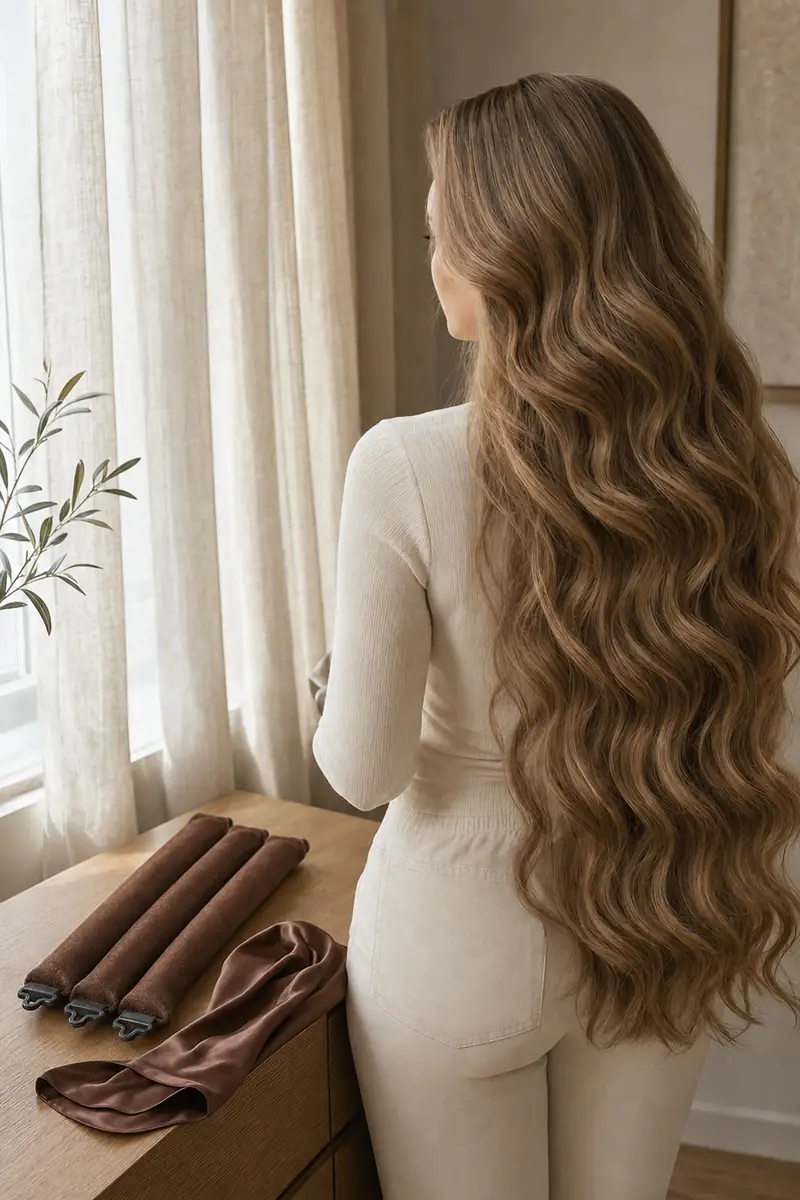
What to look for in heatless curlers for long hair
If you are hunting for the best heatless curlers for long hair, those three points narrow the field quickly. Short, skinny rollers force you to cut long hair into many small sections, and each small section makes a tighter, springier curl. A thicker rod does the opposite: fewer, wider sections and a looser, fuller wave that falls like a blowout. That look is the reason this format is also called overnight blowout rods.
Each Lunelock rod is 10.6 in long and 1.4 in thick (27 × 3.5 cm), with a foam core under a velvet-soft cover and short black elastic tabs at each end: a small T-shaped plastic hook at the top, a keyhole-shaped plastic loop at the bottom. The velvet-soft cover is gentle against your hair and soft under your head through the night. If you want the difference between cover fabrics explained, read satin vs velvet heatless curlers.
How much hair one 10.6 in rod holds
That simple geometry explains most of what happens with long hair. The first turn sits on the rod itself; every turn after that sits on hair, so the roll grows a little fatter and each turn uses a little more length. The ends end up in the middle of the roll, the roots stay flat against the outside, and the rod rests against your head.
| Length you roll | Full turns, at most | What the roll looks like |
|---|---|---|
| 12 in (30 cm) | About 2½ | Slim roll, quick to dry |
| 18 in (46 cm) | About 4 | Medium roll, sits snugly against the head |
| 24 in (61 cm) | About 5½ | Full roll, spread the hair across the rod |
| 30 in (76 cm) | Just under 7 | Large roll, keep each layer flat and centered |
The length of the rod matters just as much as its thickness. At 10.6 in (27 cm), each rod is wide enough to take the whole top section, or one full side of your head, spread out in a single roll. The wider you spread a section along the rod, the thinner each layer stays, and thin, even layers dry faster and wave more evenly than a tall stack bunched in the middle.
Sectioning long hair into bigger sections
- Detangle first. Knots split a section into strands that dry in different directions. Use a wide-tooth comb or your fingers, working up from the ends.
- Part the top. Take a rectangle from your hairline back to the crown, about the width of the rod.
- Split the rest in two. Everything left over becomes the left and right sections, running from your temple down to the nape.
- Check the thickness. If a section feels too thick to lie flat across the rod, it will roll into a bulky cone. That is the signal to use smaller sections, as explained in the part on two sets further down.
Hair on the lower back of the head is often the thickest and the last to dry. Give it the same care as the top, even though you can’t see it in the mirror.
Rolling long lengths evenly and avoiding dents
Long hair rewards patience at the very start of the roll. If the tips go on crooked or folded, every turn after them follows that crease, and you wake up with a kink at the ends. Hold the rod horizontally under the ends, lay the tips flat across it, and make the first full turn slowly. Once that turn is smooth, the rest of the roll follows it.
Keep the tension even but light. There is no need to pull long hair tight to get a wave, especially while it is still a little damp:
How far wet hair that has never been chemically treated can stretch without damage. Stretched between 30% and 70%, it changes irreversibly.
— International Journal of Trichology (Gavazzoni Dias), 2015
A few habits keep the finish smooth from top to bottom:
- No elastics on the hair. A hair tie around a rolled section presses a line into it. Let the rod rest against your head and let the scarf keep the rolls in place.
- Keep the roll centered. If the hair drifts toward one end of the rod, the other end ends up bare and the roll tips over. Guide each turn back toward the middle.
- Roll all the way up. Stop with the rod against your scalp so the roots are lifted too; that is where the blowout volume comes from.
- Try the spiral for definition. For more defined waves, you can also wind a section down a rod held upright, as shown in the rod tutorial.
Weight and hold on long hair
Water is the main reason long rolls take longer than short ones. Hair takes up a surprising amount of it, and a thick roll traps it between layers:
Water a fully hydrated hair can take in, relative to its own dry weight
So on wash days, towel-dry well or let your hair air-dry most of the way before you roll. The overnight guide on wet or dry hair explains how damp is damp enough. If your waves tend to drop by the afternoon, the tips in how to make heatless curls last cover humidity, products and how to set the roll.
The ends of very long hair are also years older than the roots:
About 1 cm a month: how fast a scalp hair grows during its growth (anagen) phase
— Deutsches Ärzteblatt International (Wolff, Fischer and Blume-Peytavi), 2016
How long the growth (anagen) phase lasts; the maximum length hair can reach depends on it
— Deutsches Ärzteblatt International (Wolff, Fischer and Blume-Peytavi), 2016
At that pace, the last inches of a 24 in (61 cm) length started growing about five years ago. That is one more reason to set long hair without heat: the rods shape your waves while you sleep, with no curling iron and no hot air on those older ends. For a closer look at the question, read do heatless curls damage your hair.
Sleeping with long rolls
Long hair makes big rolls, and the scarf is what keeps them together through the night. Fold it into a wide band or a triangle, lay it over the rolls, and tie it so it holds them without squeezing. Tuck any loose ends of hair under the scarf so they don’t catch on the pillow. The guide to tying a satin scarf over heatless curls shows several ways to wrap it.
“works, is comfy and stayed on all night”— Verified buyer
The first night can feel new, and that is normal with any overnight set. As one buyer put it:
“I have to use it more often to get used to it. But you sleep with them comfortably.”— Verified buyer
Finishing long waves in the morning
On long hair, the waves look their fullest after a few minutes of finger-combing. Start at the ends, separate each wave into two or three smaller ones, then work upward. A wide-tooth comb is fine for a smoother, glossier finish; a fine brush tends to turn waves into frizz. If one section came out flatter than the others, it was usually thicker or damper when you rolled it: next time, split it or give it more drying time.
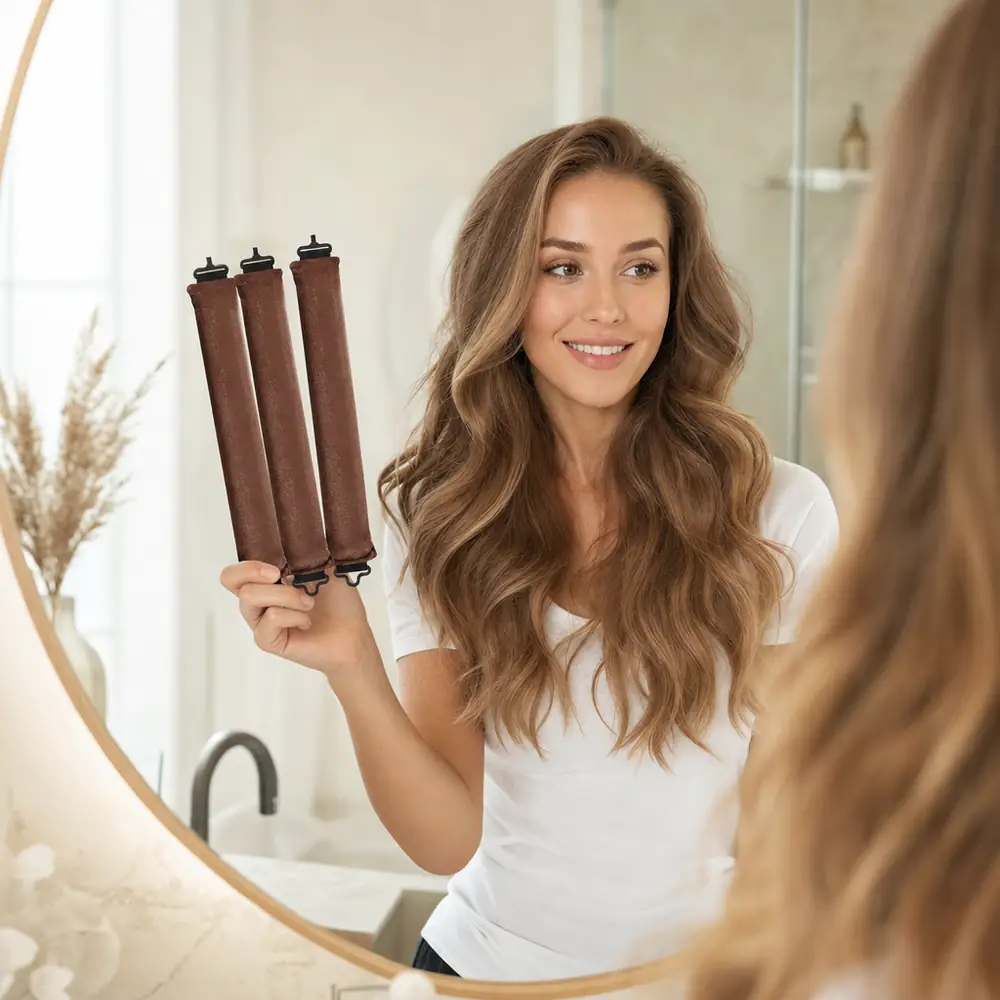
Heatless curls for long hair, by length and thickness
Use this table as a starting point, then adjust after the first night. The more hair you roll on one rod, the bigger the roll and the longer it needs to dry.
| Your hair | Fine or thin | Medium | Thick |
|---|---|---|---|
| Shoulder to collarbone | Three sections, one rod each; roll dry | Three sections; roll dry or barely damp | Three sections; check the lower sides are fully dry |
| Mid-back | Three sections; spread each across the whole rod | Three sections; keep the tips flat and centered | Consider a second set and six smaller sections |
| Waist and longer | Three sections; roll slowly so layers stay flat | Three sections or a second set for smaller rolls | Two sets, or the Classic Curling Rod for the full length |
Fine hair tends to be the easiest to roll, since three big sections still lie flat on the rod.
“They seemed to work pretty good on my thin hair. Glad a bought them!”— Verified buyer
When two sets help with very thick or very long hair
Six rods is a practical layout for very full hair: two on top, one behind the other, and two on each side, one above the other. Each roll then holds less hair, so the layers stay thin and the waves come out more alike from front to back. The second set also comes with its own satin scarf, which is handy as a spare or for travel. Some buyers keep one set in a bag for trips:
“Looks like I just had my hair done when I take these out. Beautiful volume. I would definitely repurchase. I keep a set at home and a set in my travel bag.”— Verified buyer
Choose the two-set option in the box above, or start with one set and add a second once you know how your hair rolls.
The Classic Curling Rod option for long hair
If you prefer one piece to three, the Lunelock Classic Curling Rod is a single 59 in (150 cm) foam rod with a velvet-soft cover. You lay its middle across the top of your head like a headband, twist each half of your hair around one side of the rod, and hold the ends with the two matching scrunchies or by tying the ribbon ends in a bow. Because the rod runs down both sides, it follows long hair along its full length and gives soft, flowing waves from the crown to the tips. The three-rod set gives big, voluminous blowout-style waves, and the Classic Curling Rod gives soft waves along the whole length. Both suit long hair, so pick the look you like best.
More guides for heatless curls
If someone in your home has a shorter cut, the guide to heatless curls for short hair adapts the same rods to shorter lengths. Curious how rods compare with the old tube-sock trick? Read sock curls vs a heatless curling rod. And for all colors and the full set, head to the Lunelock heatless curling rod page.
Heatless curls for long hair: your questions
Should long hair be wet or dry for heatless curls?
Dry or barely damp. Long hair holds a lot of water, and a thick roll dries slowly from the inside, so start with hair that feels almost dry to the touch. Towel-dry freshly washed hair well, or let it air-dry most of the way, then roll. Dripping-wet lengths are the one state to avoid.
How do you do heatless curls on very long hair?
Split your hair into three big sections, top, left and right, and give each one a rod. Start at the tips, smooth them flat against the rod, then roll up toward the scalp, spreading the hair across the width of the rod so each layer lies flat. Tie the satin scarf over the rolls and sleep.
Is 2 hours enough for heatless curls on long hair?
It depends on how dry your hair is when you roll it. The rods need to stay in until every layer is completely dry, including the one touching the rod. With long, thick rolls that is easiest overnight. For a short window, start with fully dry hair so there is no water left to wait for.
What is the easiest way to curl long hair without heat?
Three rods and a scarf. Roll one big section around each 10.6 in (27 cm) rod, from the tips up to the scalp, rest the rods against your head, tie the satin scarf over them and go to bed. In the morning, unroll gently and break up the waves with your fingers.